
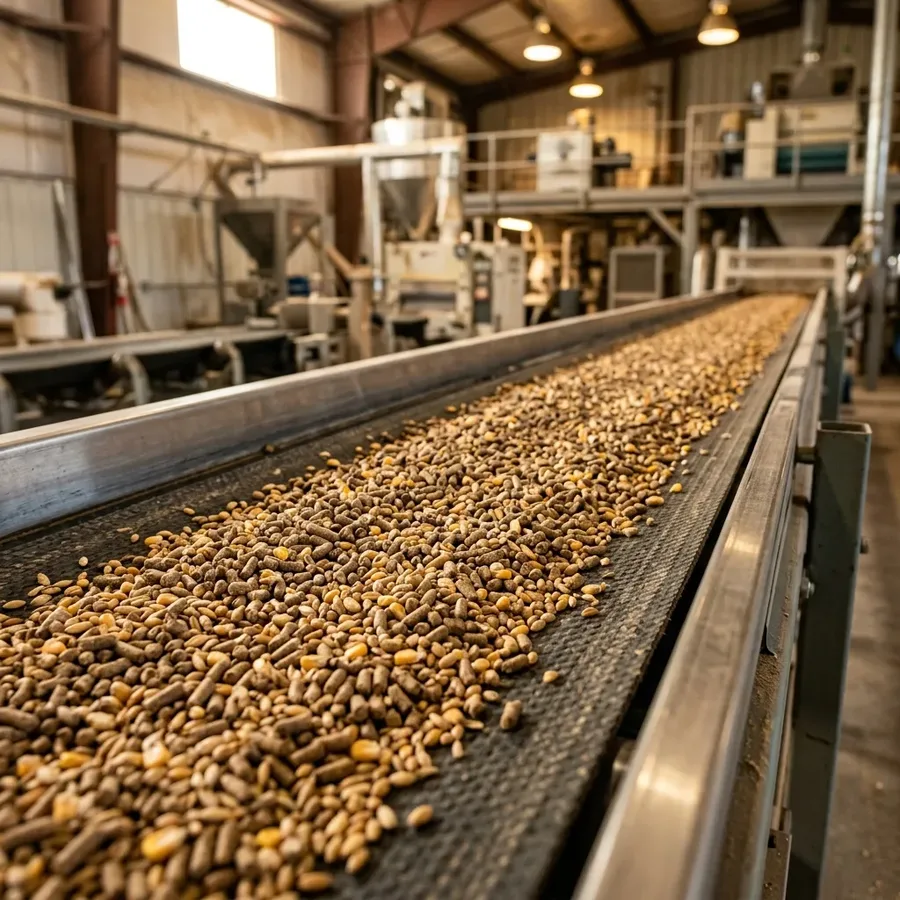
The Control Problem in High-Speed Kibble Extruders
Pet food extrusion requires strict control of moisture levels to ensure correct starch gelatinization, kibble density, and product stability. Excess moisture results in mold growth and packaging failures; under-moisture causes excessive kibble breakage and product yield loss. Furthermore, vacuum fat coating must be carefully dosed based on the dry density and moisture of the raw kibble exiting the extruder dryer.
Continuous At-line and Chute Sensors
Using the USTECH ProLine17ES analyzer mounted directly over the extruder dryer exit conveyor chute, the plant monitored moisture and fat continuously. The sensor measures through a sapphire window, protected from dust and vibration. Real-time moisture data is fed into the extruder's PLC, enabling closed-loop water addition control before the conditioning phase.
Conclusion
Continuous closed-loop moisture control reduced kibble moisture variance from ±0.65% to ±0.15%, allowing the plant to safely raise the moisture target by 0.4% without violating the 10.0% maximum safety threshold, generating significant raw material yield increases.
References
- ISO 12099 - Animal feeding stuffs, cereals and milled cereal products — Guidelines for the application of near infrared spectrometry.
- "Extrusion Process Control for Companion Animal Diets Using Real-Time Near-Infrared Analytical Technology," Journal of Food Engineering, 2023.