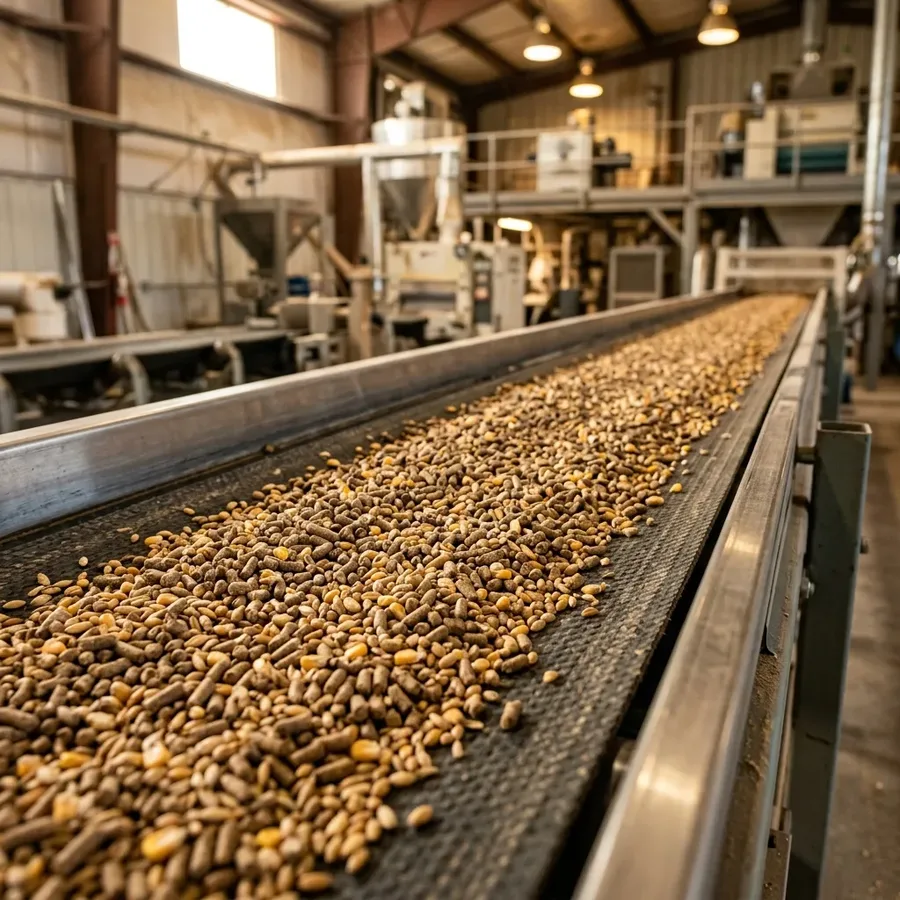
Compound feed mills in the food and feed industry blend a diverse mix of grains, meals, and co-products to formulate species-specific feed rations. For these operations, crude fiber (CF) and mineral (total ash) fractions are subject to strict regulatory labeling rules. Furthermore, fiber content determines digestion performance and gut health. Traditional crude fiber testing (acid/base extraction) takes hours, and ash verification requires heating ovens to 550°C, meaning mill operators usually get results a day late.
"MEMS-based FT-NIR technology measures moisture, protein, fat, fiber, and ash in animal feed simultaneously, giving operators actionable data in 60 seconds."
Analytical Methodology and Chemometrics
Spectroscopic assessment of fiber and ash parameters relies on the absorption behaviors of organic matrices. Although minerals (ash) do not absorb NIR light directly, they exhibit strong correlations with hydrogen-bonded salts and hydration bands in organic components. Our USTECH MasterLine at-line features an automated sample cup to deliver high-quality scans of finished feeds and raw meals.
Collected spectra are preprocessed inside `caliX` with scatter correction (SNV) and 1st derivative filters to eliminate particle-size variance. The PLS regression models then correlate this processed spectral data to reference lab values. True model portability is maintained thanks to our highly stable silicon-MEMS chip interferometer alignment.
FT-NIR Feed Calibration Accuracy Metrics
The table below summarizes calibration performance and validation accuracy (RMSEP) compared to standard ISO wet chemistry references:
| Parameter | Reference Standard | Calibration Range | FT-NIR Accuracy (RMSEP) | Correlation (R²) |
|---|---|---|---|---|
| Crude Fiber | ISO 6865 (Filtration) | 1.0 – 25.0% | ≤ 0.20% | 0.984 |
| Total Ash | ISO 5984 (Muffle Furnace) | 0.5 – 15.0% | ≤ 0.15% | 0.978 |
| Crude Protein | ISO 5983 (Kjeldahl) | 8.0 – 24.0% | ≤ 0.12% | 0.993 |
| Moisture | ISO 6496 (Oven) | 8.0 – 16.0% | ≤ 0.08% | 0.989 |
Key B2B Value Additions
Real-time feed analysis supports mill efficiency in several key areas:
- Formula Optimization: Limits over-addition of expensive protein or fat ingredients, lowering the overall cost of feed formulations.
- Co-product Monitoring: Tracks highly variable agricultural co-products (e.g. wheat bran or DDGS) as they arrive, adjusting formulations to keep fiber within spec.
- Energy Savings: Reduces muffle furnace heating runs in the laboratory, cutting daily operational energy consumption.
Conclusion
USTECH Innovations feed analyzers allow compound feed mills to replace legacy batch testing with instant, multi-parameter validation, maximizing profit margin and product quality.
References
- ISO 6865 - Animal feeding stuffs — Determination of crude fibre content — Method with intermediate filtration.
- ISO 5984 - Animal feeding stuffs — Determination of crude ash.
- "Evaluation of MEMS FT-NIR technology for rapid ash and fibre prediction in commercial compound poultry feed," Journal of Feed Science, 2024.