Selecting an inline FT-NIR analyzer is a significant capital decision. The instrument will be integrated into your production line, generating quality data for years — and the performance of your quality control program will depend on that data being accurate, reliable, and available when you need it. The market offers a range of options, from large multinational instrument manufacturers to specialized process analytics providers. Technical specifications are important, but they tell only part of the story. The five questions below address the factors that matter most for long-term performance in a production environment.
1. How Does It Handle Real Production Conditions?
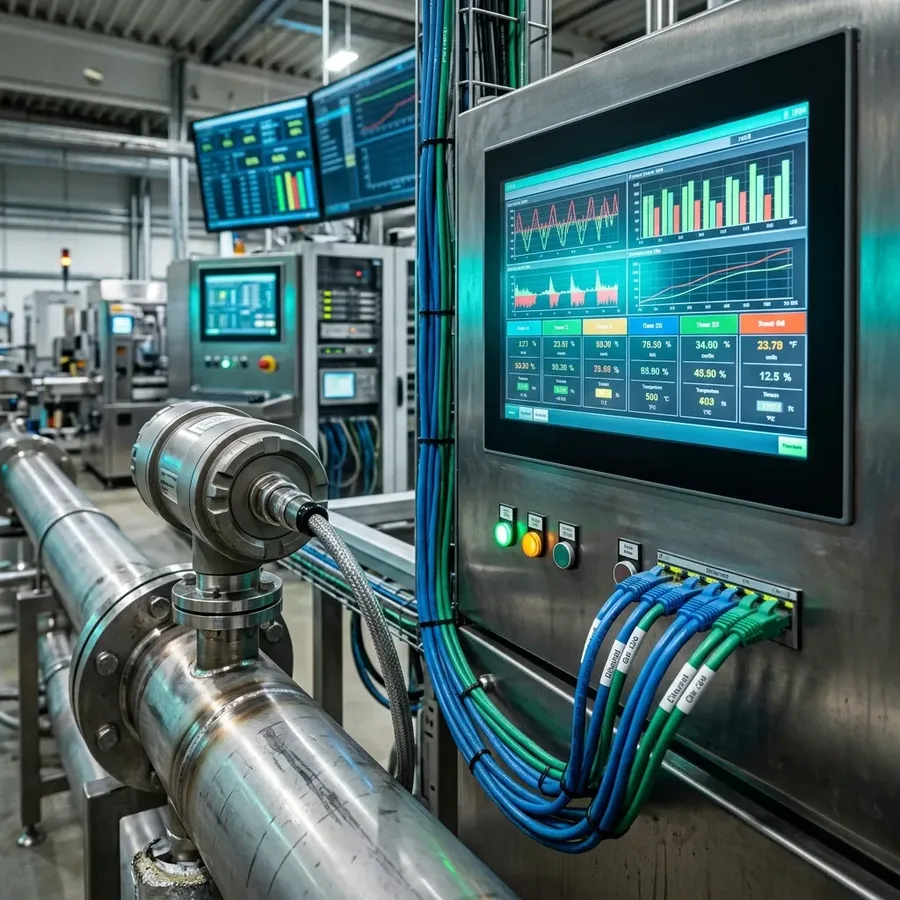
Laboratory FT-NIR instruments are designed for controlled environments: stable temperatures, predictable sample presentation, and trained operators. An inline analyzer faces a fundamentally different set of conditions — temperature fluctuations, vibration, dust, humidity, and the continuous variation inherent in real production materials.
Ask specifically about the instrument’s IP protection rating. IP65 means the instrument is fully protected against dust ingress and against water jets — the minimum standard for most food and feed production environments. The ProLine2550 carries an IP65 rating, operates from 24V DC, and includes integrated temperature control.
"An inline analyzer that cannot survive your production floor is an expensive paperweight. IP protection, temperature stability, and vibration tolerance are not optional — they are prerequisites."
2. What Calibration Models Are Available — and Who Maintains Them?
An FT-NIR analyzer is only as accurate as its calibration models. Before purchasing, clarify what pre-built calibration models are available for your specific application. Equally important is understanding the ongoing calibration maintenance process. Calibration models require updating as raw materials change, new suppliers are added, or formulations evolve.
Also ask about calibration transfer: if you deploy multiple instruments across different facilities, can calibration models be transferred between instruments? Tools like the caliX Spectral Suite simplify calibration development and maintenance, but the vendor’s commitment to long-term calibration support is equally critical.
3. How Does It Connect to Your Existing Automation Infrastructure?
An inline analyzer that cannot communicate with your existing PLC or SCADA system is an island of information. Ask specifically about the instrument’s data communication interfaces. Prefer instruments that support standard, open protocols — Ethernet TCP/IP, HTTP, Modbus TCP, or OPC-UA.
Also consider the data management software. A dedicated software platform like ProChem — which provides real-time measurement display, historical data storage, CSV export, and PLC integration — reduces the integration burden on your automation team.
4. What Does the Physical Installation Require?
Inline analyzer installation is not trivial. The instrument must be mechanically integrated into the production line. Before purchasing, get a clear picture of the installation requirements: what process interface configurations are supported, what the installation footprint is, what utilities are required (power, compressed air, cooling), and what the estimated installation time and production downtime will be.
The ProLine2550 weighs 3.1 kg and requires only 24V DC power and an Ethernet connection — significantly reducing the complexity and cost of installation compared to traditional laboratory-grade instruments.
5. What Does After-Sales Support Look Like?
An inline analyzer is a production-critical instrument. When it is offline, your real-time quality data is offline. Ask about response time for technical support requests. Ask whether remote diagnostics are available. Ask about spare parts availability and lead times.
Also ask about the manufacturer’s roadmap for calibration support and software updates. An instrument purchased today should be receiving software updates and calibration support five years from now.
Making the Right Decision
The right inline FT-NIR analyzer is not necessarily the one with the longest specification sheet or the most recognizable brand name. It is the one that performs reliably in your specific production environment, integrates with your existing automation infrastructure, comes with validated calibration for your applications, and is supported by a team that understands your operational requirements.
"Have questions about the ProLine2550? Contact USTECH — we’ll answer all five, and more."