
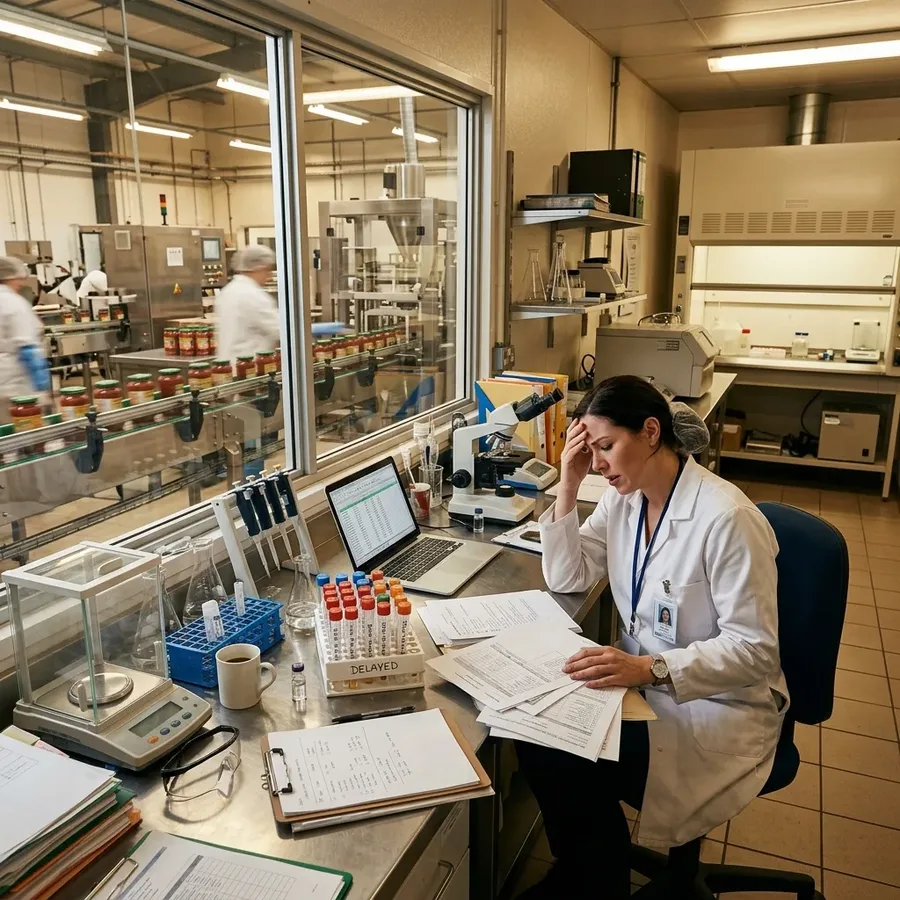
When food and feed manufacturers evaluate the cost of their quality control infrastructure, laboratory testing appears as a line item that is relatively straightforward to calculate: equipment depreciation, reagent costs, staff salaries, and facility overhead. These direct costs are visible, auditable, and familiar. What is rarely calculated — and rarely appears on any budget report — is the cost of what lab-based quality control cannot do. The costs generated by analytical delay, by the gap between production and measurement, and by the decisions made in the absence of real-time data. These costs are real, they are significant, and in many manufacturing environments they dwarf the direct cost of running the laboratory.
The Cost of Analytical Lag
Every manufacturing operation that relies on laboratory testing has an analytical lag — the time between when a product is made and when quality data about that product is available. Depending on the laboratory, the method, and the logistics involved, this lag typically ranges from 30 minutes to several hours. During this window, the production line does not stop. If a process parameter drifts out of specification — moisture too high, protein below target, fat content exceeding the declared value — production continues generating non-conforming product until the laboratory result arrives and a corrective action is initiated.
"The cost of analytical lag is not abstract. It is the volume of non-conforming product that must be reworked or discarded — and the energy, labor, and capacity consumed during every minute of undetected deviation."
The Cost of Rework and Reprocessing
Rework is one of the most expensive activities in any manufacturing operation. It consumes labor, energy, and production capacity that could be generating revenue. It introduces variability into products that have already been processed once. And it creates traceability and documentation challenges that add administrative burden.
The frequency of rework events in a manufacturing operation is closely correlated with the speed of quality feedback. Operations that receive quality data hours after production are structurally more likely to generate rework-triggering deviations than operations that receive quality data in real time. Inline analyzers like the ProLine2550 close this feedback loop, delivering continuous compositional data directly from the process stream.
The Cost of Yield Giveaway
Yield giveaway is the practice — often unconscious — of formulating product above target specification to ensure compliance. If your laboratory tells you moisture content three hours after production, your process must be calibrated to run well below the maximum allowable moisture to ensure that no batch ever tests above the limit. This safety margin is expensive.
If you are producing dairy powder and your specification allows up to 4% moisture, but you routinely target 3.2% to compensate for measurement uncertainty and lag, you are evaporating more water than you need to — consuming energy and reducing yield. Real-time inline measurement allows you to tighten that margin safely, running closer to the specification limit with confidence because every measurement is current.
The Cost of Sampling Variability
Laboratory-based quality control is dependent on the quality of the samples collected. Sampling protocols introduce their own sources of variability: where in the process the sample is taken, how representative it is of the batch, how it is handled and transported, and whether it degrades between collection and analysis.
For bulk materials — grain, feed ingredients, dairy powder — a grab sample represents a tiny fraction of the batch it is meant to characterize. Inline NIR analyzers eliminate this problem entirely by measuring the full product stream continuously, providing a far more representative and statistically robust picture of product quality than any sampling protocol can achieve.
The Cost of Compliance Documentation
As food safety regulations have tightened — through frameworks such as FSMA in the United States, the EU Food Safety Regulation, and major retailer audit schemes — the documentation burden associated with quality control has grown substantially. Laboratory-based testing generates records, but typically at the frequency of sampling.
Auditors and certification bodies increasingly expect continuous, traceable quality data. Real-time process analyzers generate this data automatically, creating a comprehensive digital record of every production run that satisfies auditor requirements with far less manual effort than laboratory-based documentation workflows.
Quantifying the True Cost of Lab-Based QC
When manufacturers fully account for rework costs, yield giveaway, sampling variability losses, and compliance documentation overhead — in addition to direct laboratory operating costs — the total cost of lab-based quality control is consistently higher than the direct cost suggests.
The business case for inline real-time measurement is not primarily about replacing the laboratory. It is about eliminating the costs generated by the delay between production and analytical feedback. By closing the gap between production and measurement, inline analyzers turn quality control from a retrospective audit into a proactive process optimization tool — reducing waste, improving yield, and strengthening compliance simultaneously.
"Ready to quantify the cost of analytical lag in your operation? Contact USTECH to discuss how the ProLine2550 can help."

