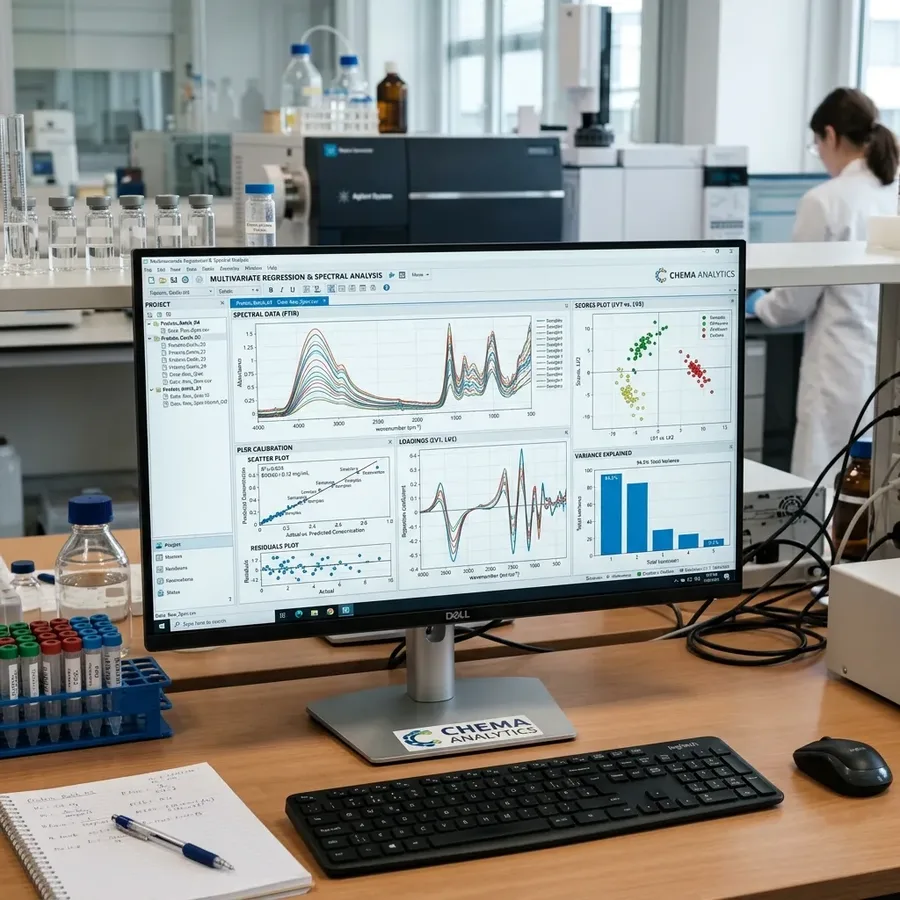
In industrial process analytics, developing a robust chemometric calibration model is a significant investment. Using tools like the caliX Spectral Suite, users can easily configure parameter regressions. It requires collecting hundreds of physical samples, scanning them across variable conditions, and running expensive laboratory reference tests (like Kjeldahl for protein or Soxhlet for fat) to train PLS regression models. Historically, the biggest frustration for quality assurance managers has been calibration transfer: the process of taking a model built on a "master" instrument and attempting to run it on secondary instruments deployed across other production lines and integrated into chemical and pharmaceutical processes or factories.
"In traditional benchtop FT-NIR spectrometers, minor unit-to-unit optical differences in hand-aligned Michelson interferometers alter the spectral response, forcing chemometricians to rebuild models or calculate complex standardization matrices."
The Root of the Transfer Problem
Traditional Fourier Transform Near-Infrared (FT-NIR) systems rely on macroscopic moving mirrors. These mirrors must move with nanometer-scale precision relative to one another. Despite strict quality controls, minor variances in optical alignment, optical component coatings, and light source focal profiles lead to minute spectral shifts between two identical instruments from the same production line. Consequently, a model built to predict protein content on Line A might show a systematic bias of 0.5% when run on Line B, rendering it useless without tedious standardization (e.g., Piecewise Direct Standardization or PDS).
How Silicon MEMS Redefines Manufacturing
Micro-Electro-Mechanical Systems (MEMS) technology bypasses human assembly and mechanical tolerances entirely by utilizing semiconductor fabrication processes. Rather than mounting mirrors, beamsplitters, and actuators individually on a chassis, the entire optical engine is etched directly onto a single silicon wafer in a cleanroom environment using photolithography.
Because the etching masks are accurate to the sub-micron scale, unit-to-unit optical differences are minimized to near-zero levels. The optical path length, collimation angles, and beam split characteristics are practically identical across thousands of chips from the same silicon run. This brings a massive benefit to industrial clients: true calibration portability.
Comparative Spectral Match Metric
To evaluate unit-to-unit similarity, USTECH engineers ran matching experiments scanning standardized reference standards (99% pure polytetrafluoroethylene and rare earth oxides) across ten production-line ProLine2550 MEMS spectrometers. The results demonstrate near-perfect alignment:
| Metric | Traditional Laboratory FT-NIR | Diode Array Dispersive | USTECH MEMS FT-NIR |
|---|---|---|---|
| Wavelength Accuracy | ±0.05 nm | ±0.50 nm | ±0.02 nm |
| Unit-to-Unit RMS Noise Difference | < 150 µAU | < 500 µAU | < 80 µAU |
| Average Transfer Error (Without correction) | 0.28% bias | 0.65% bias (requires rebuild) | < 0.04% bias |
Real-World B2B Impact
For large-scale food processors or pharmaceutical corporations, this technology yields immediate cost savings:
- Rapid Deployment: Develop a master calibration database for your grain or pharmaceutical blend in your central laboratory once. Push the model via the cloud to twenty factories instantly.
- No Local Standardizations Needed: Local operators do not need to scan local reference standards or perform mathematical corrections. The ProLine2550 devices, managed by the ProChem software suite, accept the master calibration drop-in.
- Drastic Lab Cost Reduction: Eliminates the need to send hundreds of calibration check samples to third-party wet labs for local alignment verification.
Conclusion
Silicon MEMS technology transitions spectroscopy from a delicate scientific laboratory art to a repeatable, robust, semiconductor-scale utility. By resolving the unit-to-unit calibration transfer problem at the physical hardware level, USTECH enables seamless process control scaling for industrial operators worldwide.
References
- ASTM E1866 - Standard Guide for Establishing Spectrophotometer Performance Tests and Measurements.
- "Feasibility of Wavelength Calibration Transfer between MEMS-based NIR Spectrometers," Journal of Near Infrared Spectroscopy, 2024.
- "Chemometric Model Portability and Standardization Protocols in Industrial Plants," Analytica Chimica Acta, 2023.