Analytical technology has advanced to the point where measurement can occur in several different locations relative to the production process — and each location comes with distinct implications for data latency, operational impact, capital cost, and quality outcomes. Understanding the difference between inline, at-line, and off-line analysis is foundational to making the right choice for your facility.
Off-Line Analysis: The Traditional Model
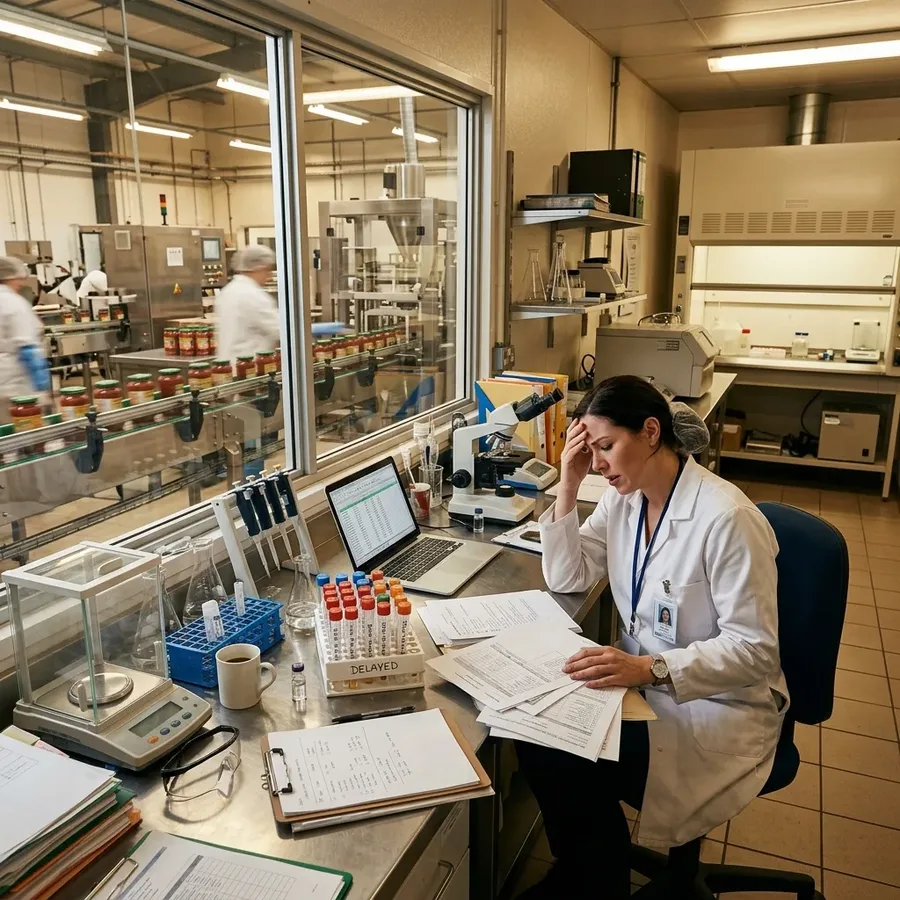
Off-line analysis is the oldest and most familiar approach. A sample is collected from the production line, transported to a laboratory — which may be in a different building or facility — and analyzed using dedicated laboratory equipment. Results are then communicated back to the production team.
The advantages are well-known: laboratory conditions can be tightly controlled, certified reference methods can be applied, and highly specialized analytical equipment can be used. The disadvantages are equally well-known. The time between sample collection and result delivery can range from 30 minutes to several hours. During that window, the production line continues to run.
"In a high-throughput production environment, even a 30-minute delay between sample collection and result delivery can mean tonnes of out-of-specification product advancing through the line before any corrective action is taken."
At-Line Analysis: Closing the Loop Partially
At-line analysis moves the measurement instrument to the production floor — typically adjacent to the production line. Samples are still collected manually and brought to the instrument for measurement, but the instrument itself is located near the process rather than in a remote laboratory.
This approach reduces the time from sample collection to result, typically to a range of 5 to 15 minutes depending on the method. The limitation remains: at-line analysis still depends on manual sampling. It provides a faster feedback loop than off-line analysis, but it does not provide continuous process monitoring. For facilities exploring at-line configurations, devices like the ProChem offer a versatile benchtop solution that bridges the gap between laboratory and production floor.
Inline Analysis: Continuous, Real-Time Process Intelligence
Inline analysis integrates the measurement instrument directly into the production line. The analyzer measures the product or material continuously as it flows through pipes, chutes, or conveyors — with no manual sampling and no measurement delay. The result is a continuous stream of analytical data reflecting actual process conditions in real time.
Process deviations are detected as they occur, enabling immediate corrective action before out-of-specification product advances further in the line. The ProLine2550 is purpose-built for this integration mode, delivering continuous FT-NIR measurement directly within the process stream.
Comparing the Three Approaches
The following table summarizes the key differences across the three measurement strategies:
| Criterion | Off-Line | At-Line | Inline |
|---|---|---|---|
| Response Time | 30 min–hours | 5–15 min | Seconds (continuous) |
| Coverage | Point-in-time snapshots | Point-in-time snapshots | 100% production stream |
| Operator Dependency | High | Medium | Autonomous |
| Capital Cost | High (lab infrastructure) | Medium | Medium-High (instrument + integration) |
| Operating Cost | High (reagents, labor) | Medium | Low (automated) |
Choosing the Right Approach for Your Operation
The right choice depends on your process, your quality requirements, and your operational context. Each approach has a valid role to play in a comprehensive quality control strategy:
- Off-line analysis remains essential for regulatory compliance, method validation, and final product certification. It serves as the reference baseline against which other methods are calibrated.
- At-line analysis is appropriate for lower-throughput operations where the cost of delayed results is manageable, or as a supplementary check alongside inline systems.
- Inline analysis provides the highest value in high-throughput production environments, where the cost of out-of-specification product is significant and continuous process visibility drives measurable ROI.
Many facilities find that the optimal strategy is a combination: inline analyzers for real-time process control, with periodic off-line or at-line checks for regulatory verification.
"USTECH's ProLine2550 is designed exclusively for inline integration. Contact us to discuss how it fits your production environment."