Milk powder manufacturing is an energy-intensive process relying heavily on spray drying. In these operations, final product moisture and protein concentrations represent key quality, legal, and economic indicators. Traditionally, moisture analysis involves oven drying which takes hours, while protein validation relies on wet chemistry methods like Kjeldahl, which require multiple preparation steps. This lag prevents operators from executing immediate process adjustments to resolve quality deviations.
"The ProLine2550 MEMS FT-NIR system monitors dried milk powders at-line or directly inline inside discharge pipelines, delivering composition profiles in less than 60 seconds."
Measurement Principles and Calibration
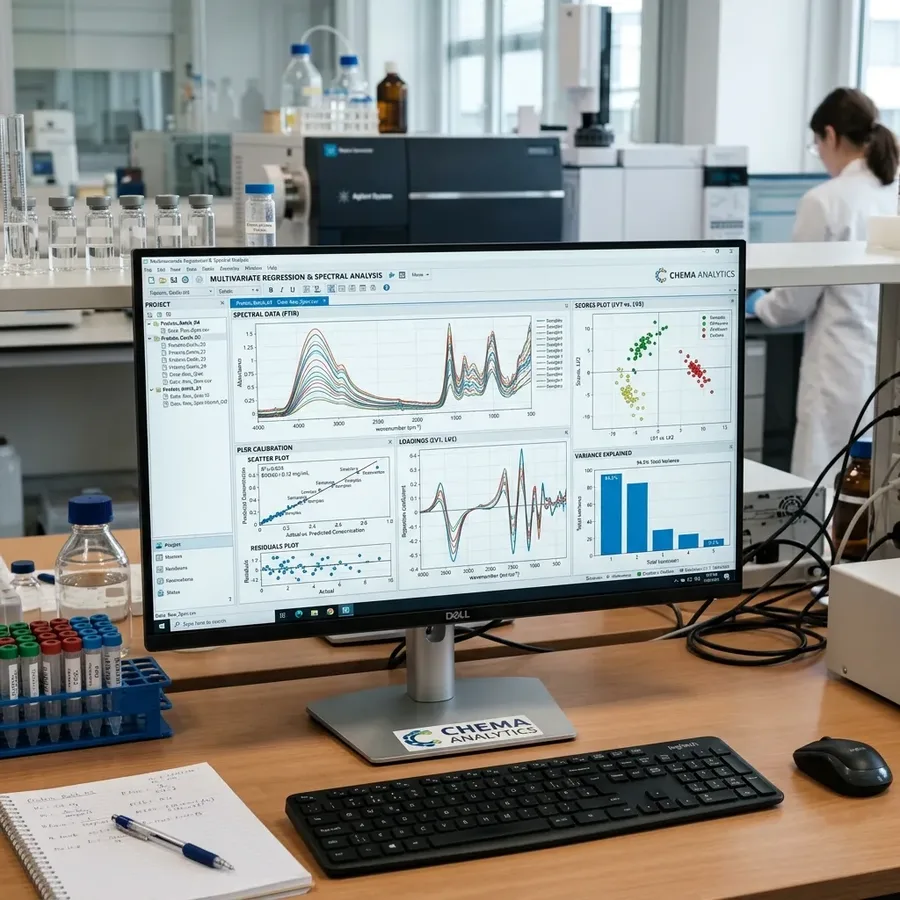
Near-infrared (NIR) spectroscopy relies on the absorption characteristics of chemical bonds in milk powder constituents. Water (moisture) O-H bonds exhibit strong absorption bands at 1450 nm and 1940 nm, whereas protein N-H bonds display primary piks around 2180 nm. Using the caliX AutoML software, these spectral profiles are mathematically translated into precise constituent concentrations through PLS (Partial Least Squares) regression.
Our silicon-based MEMS interferometer engines, utilized in the ProLine17EC Analyzer, minimize unit-to-unit optical drift. Consequently, calibration models developed in central laboratories are fully portable and can be deployed directly to factory units without local corrections.
FT-NIR vs. Reference Methods Validation
The comparative table below outlines the correlation (R²) and accuracy (RMSEP) of the USTECH FT-NIR system compared to standard reference laboratory protocols:
| Parameter | Reference Method | Calibration Range | FT-NIR Accuracy (RMSEP) | Correlation (R²) |
|---|---|---|---|---|
| Moisture | ISO 5537 (Oven Drying) | 1.50 – 6.00% | ≤ 0.08% | 0.985 |
| Protein | ISO 8968 (Kjeldahl) | 10.0 – 40.0% | ≤ 0.12% | 0.991 |
| Butter Fat | ISO 17189 (Gravimetric) | 0.50 – 30.0% | ≤ 0.10% | 0.988 |
Key B2B Value Additions
Integrating online FT-NIR systems in milk powder dairy facilities secures three primary B2B benefits:
- Prevention of Over-drying: Keeps moisture values as close as possible to the legal limit (e.g., 4.00%), maximizing product yield weight and saving significant thermal energy.
- Sticky Clog Prevention: Spray drying tower clogs occur when outlet moisture peaks. Real-time notifications allow operators to adjust feed rate to prevent powder clogs.
- Accelerated Batch Release: Replaces lab test holding periods, letting quality assurance managers release finished product packages directly upon bagging.
Conclusion
USTECH Innovations MEMS FT-NIR solutions bypass wet chemistry bottlenecks, providing dairy plants with precision process control and sustainable quality assurance.
References
- ISO 5537 / IDF 26 - Dried milk — Determination of moisture content (Reference method).
- ISO 8968-1 / IDF 20-1 - Milk and milk products — Determination of nitrogen content (Kjeldahl method).
- "Rapid Prediction of Moisture and Protein in Skimmed Milk Powder using handheld MEMS NIR Spectroscopy," Dairy Science Journal, 2025.