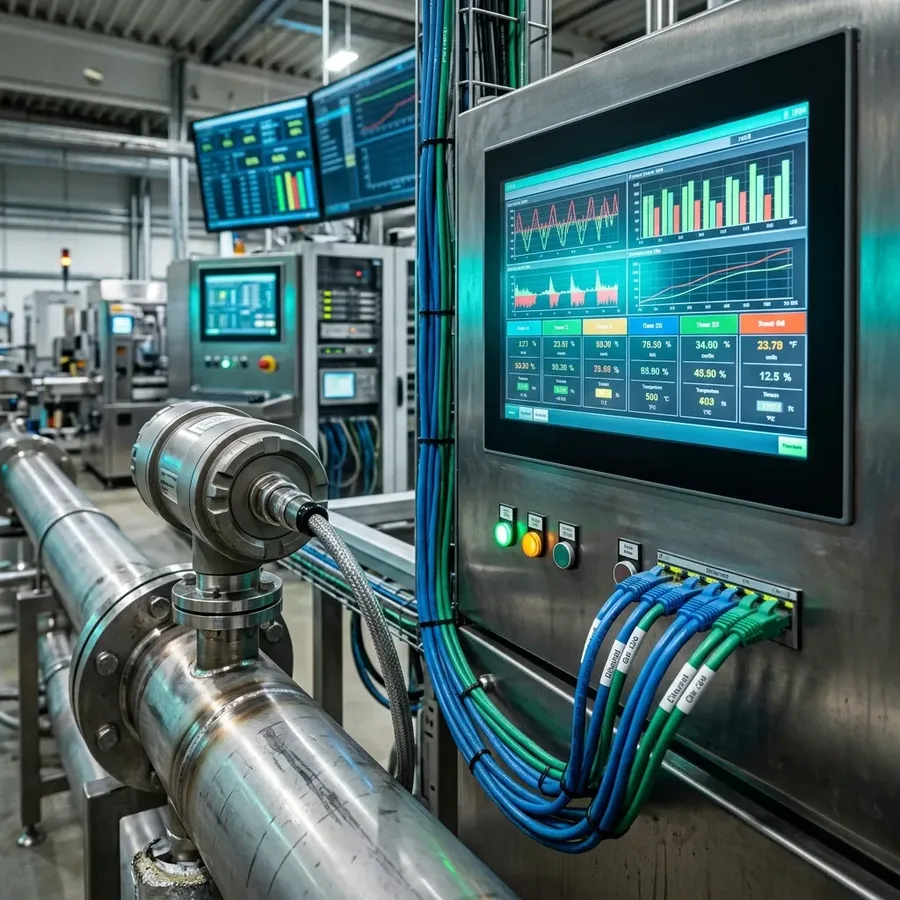
When evaluating analytical instrumentation for inline process control, the distinction between NIR technologies is one of the first technical questions that arises. Not all NIR instruments work the same way. Three fundamentally different optical architectures exist in commercial use, each with distinct performance characteristics. Understanding these differences is essential when evaluating NIR instruments for inline industrial applications.
1. Filter-Based NIR: The First Generation
The simplest NIR instruments use 6–20 fixed narrow-band optical filters. Each filter transmits only a specific, pre-selected wavelength of light. The instrument measures absorption at these discrete points and uses simple linear relationships to calculate composition values.
Filter-based instruments are simple, robust, and inexpensive. However, they are permanently limited to factory-configured parameters. You cannot add new parameters, improve calibrations, or adapt to new products in the field. Once the filters are set, the instrument’s analytical capability is fixed.
2. Dispersive NIR: The Second Generation
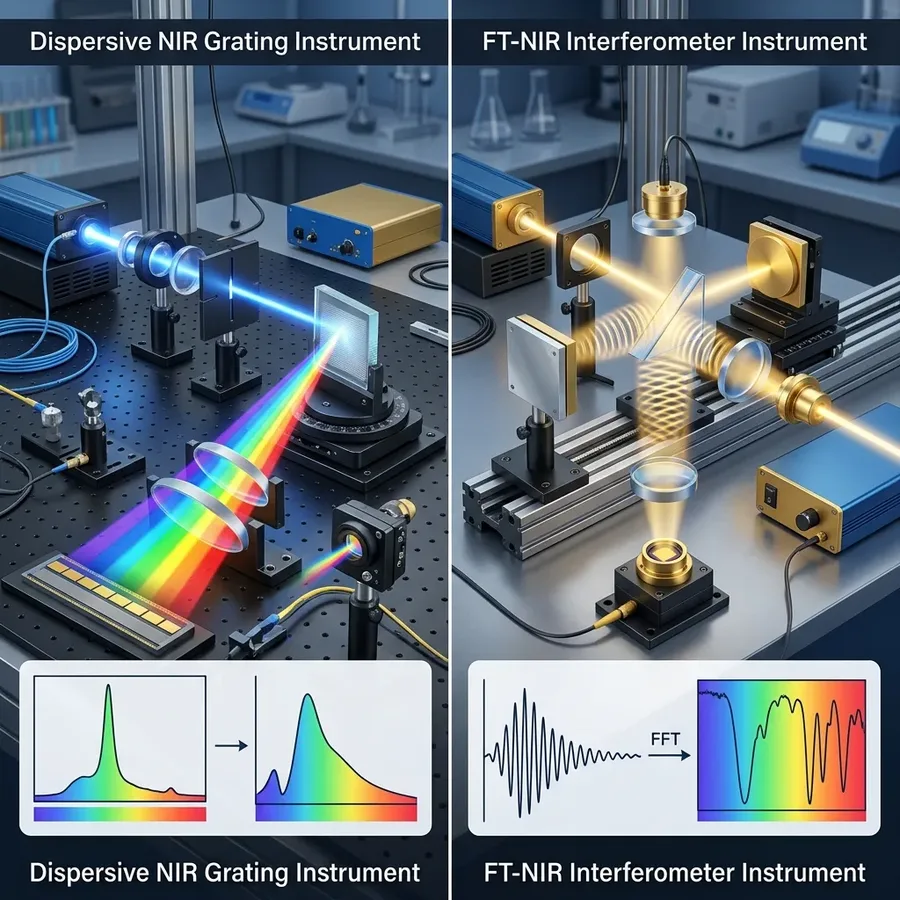
Dispersive NIR instruments use a diffraction grating to spread NIR light into a continuous spectrum. This enables multi-parameter calibrations and provides more flexibility than filter instruments. However, dispersive systems are sensitive to temperature and vibration, require regular wavelength recalibration, and typically cover only up to 1,700 nm — missing the critical 2,000–2,500 nm combination band region where many analytically important absorption features reside.
3. Fourier Transform NIR (FT-NIR): The Third Generation
FT-NIR uses an interferometer — light is split, travels two path lengths, recombines producing an interferogram containing information from all wavelengths simultaneously. A Fourier Transform converts this to a conventional spectrum.
The key physics advantages are the Fellgett advantage (dramatically better signal-to-noise ratio because all wavelengths are measured at once) and the Jacquinot advantage (higher optical throughput from the circular aperture). The result: superior accuracy, wider spectral range (1,350–2,550 nm on the ProLine2550), and laser-referenced wavelength stability that eliminates drift.
Three Generations Compared
| Property | Filter NIR | Dispersive NIR | FT-NIR (ProLine2550) |
|---|---|---|---|
| Spectral Range | 6–20 fixed points | 900–1,700 nm typ. | 1,350–2,550 nm |
| Signal-to-Noise | Low | Moderate | Very High (Fellgett) |
| Wavelength Stability | Fixed filters | Requires recal. | Laser-referenced |
| Parameter Flexibility | Factory fixed | Multi-parameter | Unlimited |
| Temp. Sensitivity | Low | Moderate–High | Low w/ compensation |
| Combination Bands | None | Partial | Full 2,000–2,500 nm |
| Cal. Transferability | Not possible | Moderate | High |
Why the 2,000–2,500 nm Region Matters
The combination band region between 2,000 and 2,500 nm contains the most analytically powerful absorption features for many key quality parameters. Only FT-NIR instruments can access this critical region:
- ● Protein N–H combination bands at 2,050–2,180 nm — most analytically useful for protein
- ● Starch C–O combination bands at 2,100–2,200 nm — superior starch prediction
- ● Cellulosic fibre bands at 2,270–2,350 nm — completely missed by short-range NIR
- ● Fat C–H combination bands in 2,300–2,450 nm with higher selectivity
“FT-NIR instruments are self-referencing: the wavelength axis is calibrated internally using a highly stable helium-neon laser. This means wavelength accuracy is maintained automatically over time and across temperature variations.”
The Key Differences in Practice
For complex matrices — such as compound feed, mixed dairy products, or pharmaceutical blends — FT-NIR’s higher spectral resolution, wider range, and superior signal-to-noise ratio translate directly into better measurement accuracy and more robust calibration models. Explore the full spectral advantage in our detailed article on the 1,350–2,550 nm range.
Implications for Inline Process Control
In a laboratory setting, the performance differences between NIR and FT-NIR can sometimes be managed through careful sample preparation, controlled measurement conditions, and regular recalibration. In an inline production environment, those compensating measures are not available.
Production lines operate continuously. Sample presentation is not uniform. Temperatures fluctuate. Vibration is present. Under these conditions, the wavelength stability and signal-to-noise advantages of FT-NIR are not theoretical — they are the difference between reliable measurement data and results that require constant validation and correction.
When Dispersive NIR Is Sufficient
Dispersive NIR remains a legitimate choice for applications with a limited number of parameters, relatively homogeneous materials, and controlled measurement conditions. At-line laboratory instruments for single-parameter measurement, or simple moisture-only applications in stable environments, may not require the added performance of FT-NIR.
The decision should be driven by the complexity of the application, the required measurement accuracy, and the conditions under which the instrument will operate — not by instrument cost alone.
The Bottom Line
For continuous inline process control in food and feed, dairy, pharmaceutical, or chemical manufacturing — where measurement conditions are variable, multiple parameters matter, and data reliability is non-negotiable — FT-NIR provides a technically superior platform. Its wavelength stability, spectral resolution, and signal-to-noise performance are specifically aligned with the demands of the production environment.
"The ProLine2550 uses FT-NIR technology engineered specifically for inline process environments. Contact USTECH to learn more."